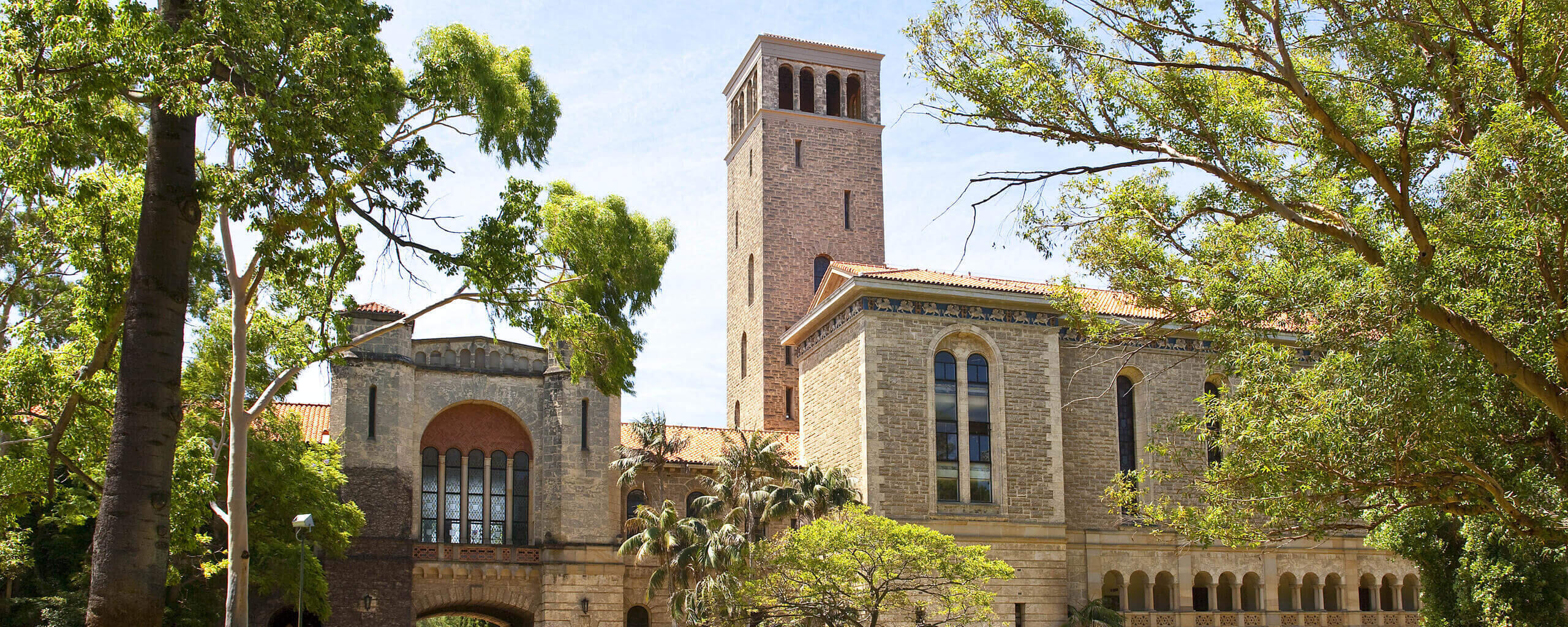
Doktorarbeit an der University of Western Australia


University of Western Australia
Location: Perth
Founded: 1911
Facts & Figures: 75 Research Centres
Since 1911, the University of Western Australia has helped shape the careers of over 100,000 graduates. Over the years the University has acquired an international reputation for excellence and enterprise. It is regarded as one of Australia's top research institutions, attracting researchers of world standing across the range of disciplines, with international leaders in many diverse fields.
UWA is proud to rank 90 in the Top 100 of Universities around the world (QS 2022). As one of the world’s elite, research-intensive universities, we are focused on being a trusted source of open and accessible research and driving excellence through world-leading collaboration. We run more than 75 research and training centres across the country. UWA received 80% of university research funding in Western Australia (WA), and our graduates are estimated to contribute $60 billion to WA's economy by 2050.
Key Research Areas
- Aboriginal and Torres Strait Islander Research
- Physical Sciences
- Biological Sciences
- Agricultural and Veterinary Sciences
- Information and Computing Science
- Engineering
- Public and Allied Health
- Built Environment and Design
- Education
- Economics
- Commerce, Management, Tourism and Services
- Studies in Human Society
- Law and Legal Studies
- History and Archaeology
Please see here all our Key Research Areas
Research Achievements
- 2005 Nobel Prize for Medicine or Physiology to Professor Barry Marshall
- 2018 Fields Medal to Professor Akshay Venkatesh
- 2020 Prime Minister's Prize for Science to Emeritus Professor David Blair (ARC Centre of Excellence for Gravitational Wave Discovery, OzGrav)
Numbers
Funding
Current Research Projects
UWA Projects
![]() | |
| University: | University of Western Australia |
| Faculty: | School Earth Sciences |
| Project Start Date: | to be confimed with Supervisor |
| Application Deadline: | open until position is filled |
| Supervisor Name: | Dr Guillaume Pirot; Dr Jeremie Giraud; Prof Mark Jessell |
| Location (City/Campus): | Crawley Campus, Perth |
| Project Description: | To manage groundwater, decision makers rely on risk assessment from ensemble of predictive models. Reducing uncertainty around decision making requires the ability to integrate jointly data and knowledge from different sources (e.g. hydrogeological, geophysical, geological, hydro-geochemistry), with different levels of uncertainty. While different inversion methods already exist, few enable the joint integration of heterogenous datasets. This project will focus on developing a practical framework that facilitate the stochastic inversion of heterogeneous dataset, while looking at the value or impact of specific data on predictive uncertainty. An important objective of the project will be to apply the framework to a real case study. This project will be carried out within the framework of the MinEx CRC and the Loop Consortia, two multi-partner industry collaborations that seek to improve our ability to build 3D geological models. Supervisors will include researchers at UWA and possibly from other institutions. Read more about the project here. |
| Funding Information: | Please apply through for a Higher Degree by Research (HDR) scholarship on the UWA website. www.uwa.edu.au/study/fees-and-scholarships/hdr-scholarships Other international scholarships matching the HDR one could be considered. |
| Special Requirements: | Willingness to learn and to take on challenging tasks. Knowledge of earth sciences and physics or maths. Aptitude or strong interest to programming. |
| Additional Information: | This project is organised in the context of a collaboration between the MinEx CRC and an ARC LOOP3D consortium. Travelling to conference is expected. |
![]() | |
| University: | University of Western Australia |
| Faculty: | School of Earth and Oceans |
| Project Start Date: | to be confimed with Supervisor |
| Application Deadline: | 03/05/2027 or whenever position is filled |
| Supervisor Name: | Dr Michael Cuttler; [email protected] |
| Location (City/Campus): | Crawley Campus, Perth |
| Project Description: | Artificial reefs are increasingly being deployed along coastlines worldwide for a range of purposes, including recreation, habitat enhancement and coastal management. While numerical and physical modelling are commonly used to inform reef design and approvals, there remains limited quantitative, field‑based evidence evaluating how artificial reefs interact with nearshore hydrodynamics, sediment transport and beach evolution once constructed, particularly in high‑energy wave environments. A central motivation for this project is the need to empirically assess post‑construction coastal response to artificial reefs, and to evaluate assumptions commonly made during the design and approval process. By resolving coastal processes across a range of temporal and spatial scales, the project will improve understanding of how reef geometry, placement and wave climate influence coastal behaviour. This project will investigate the coastal impacts of artificial reefs, with a focus on understanding how engineered reef structures modify wave transformation, nearshore circulation, sediment transport pathways and shoreline response. The research will address key knowledge gaps related to whether, and under what conditions, artificial reefs produce measurable changes to beach morphology, erosion and accretion patterns, or nearshore sediment dynamics. The project will employ a combination of field‑based observations (e.g. wave and current measurements, beach and seabed surveys, sediment monitoring) and remote‑sensing and data‑driven analyses (e.g. satellite imagery, UAV surveys, coastal monitoring datasets). Outcomes will provide robust, evidence‑based insights to inform the design, monitoring and management of artificial reefs in energetic coastal environments. Read more about the project here. |
| Funding Information: | Applicants will be required to apply for available scholarship opportunities. Any fully-funded scholarship opportunities will be linked to this project opporutnity via HDRhub. |
| Special Requirements: | Applicants should hold an Honours or Master’s degree (or equivalent) in coastal oceanography, engineering, or a related discipline. Experience in quantitative data analysis is essential. Experience with coastal fieldwork, numerical modelling, or remote sensing is desirable but not mandatory. |
![]() | |
| University: | University of Western Australia |
| Faculty: | Medical School |
| Project Start Date: | to be confimed with Supervisor |
| Application Deadline: | 01/12/2026 |
| Supervisor Name: | Dr Jonathan Chee [email protected], Institute for Respiratory Health Kofi Stevens [email protected], Institute for Respiratory Health |
| Location (City/Campus): | Crawley Campus, Perth |
| Project Description: | Background Mesothelioma is a rare and aggressive cancer with limited treatment options and poor survival outcomes. Although treatments designed to activate the immune system against cancer have demonstrated some clinical benefit, the majority of mesothelioma patients fail to respond. Emerging evidence implicates copper as a critical factor in tumour progression. Copper accumulates in mesothelioma tissue, where it promotes tumour growth, immune evasion, and resistance to chemotherapy. Drugs that bind and reduce copper levels (copper chelators) are already approved for non-cancer indications, offering a unique opportunity for drug repurposing. This project will explore how manipulating copper availability affects tumour cell behaviour, immune cell function, and overall treatment response. Our goal is to determine whether copper chelation can improve the efficacy of standard therapies and immune-based treatments in mesothelioma. Aims
Outcomes Chance to travel to Sydney to work with UNSW collaborators. Read more about the project here. |
| Funding Information: | Multiple funding sources from Cancer Council WA, WA Department of Health. |
![]() | |
| University: | University of Western Australia |
| Faculty: | Medical School |
| Project Start Date: | to be confimed with Supervisor |
| Application Deadline: | 01/12/2026 |
| Supervisor Name: | Dr Jonathan Chee [email protected], Institute for Respiratory Health Dr Nicola Principe [email protected], Institute for Respiratory Health |
| Location (City/Campus): | Crawley Campus, Perth |
| Project Description: | Project Title Immunotherapy, particularly immune checkpoint blockade (ICB), has transformed the treatment of advanced lung cancer and mesothelioma. However, up to 70% of patients do not respond to these therapies, highlighting an urgent need to improve their effectiveness. One of the major barriers to successful immunotherapy is the presence of regulatory T cells (Tregs) in the tumour. These cells suppress the immune system and prevent it from attacking the cancer. Recent research suggests that Tregs inside tumours rely heavily on cholesterol and lipid metabolism to maintain their function. Interestingly, clinical studies have shown that patients taking cholesterol-lowering drugs may respond better to ICB, suggesting a potential way to target Tregs and improve outcomes. Project Overview This project aims to understand how altering lipid metabolism, particularly cholesterol, can reduce Treg-mediated immune suppression and enhance the body’s immune response to cancer. Aims
Why Join This Project?
Read more about the project here. |
| Funding Information: | Multiple funding sources from Cancer Council WA, WA Department of Health. |
![]() | |
| University: | University of Western Australia |
| Faculty: | School of Biological Sciences |
| Project Start Date: | to be confimed with Supervisor |
| Application Deadline: | 18/05/2027 |
| Supervisor Name: | Dr. Kate Quigley [email protected] |
| Location (City/Campus): | Crawley Campus, Perth |
| Project Description: | With the systemic rise in ocean temperatures, the survival of coral reefs depends on the capacity for thermal adaptation at a scale that matches the magnitude of the global climate crisis. This research shifts the focus from isolated laboratory trials toward high-throughput applications by investigating the pace and mechanisms of Symbiodiniaceae evolution through the use of automated stress-testing platforms. By experimentally evolving symbionts, the project aims to identify the upper thermal limits of these microalgae and the subsequent physiological impacts on coral hosts, while optimizing the protocols required for scaling the production of heat-tolerant strains. Moving beyond static proof-of-concept experiments, this work integrates genetics, predictive modeling with targeted field tests to assess the performance of these symbionts within restoration pipelines, providing critical insights into the future trajectory of reef resilience and the practical feasibility of proactive, interventionist conservation in warming oceans. Read more about the project here. |
| Funding Information: | Fully-funded UWA scholarship. |
| Special Requirements: | A successful PhD candidate in this project requires strong skills in experimental design, molecular biology, and ecological genomics to conduct and analyze evolution experiments with coral-algal symbioses. Additionally, proficiency in field-work, statistical modelling, bioinformatics, and data visualization is essential to interpret complex physiological and evolutionary data in the context of climate change. Experience in laboratory techniques for culturing algae or cells is preferred, as this project involves maintaining and experimentally evolving Symbiodiniaceae strains. Hands-on expertise in algal or cell culture methods will be ideal for conducting controlled experiments and ensuring the consistency of symbiont populations across various environmental conditions. |
| Additional Information: | Potential candidates should undertake the following:
|
![]() | |
| University: | University of Western Australia |
| Faculty: | School of Biological Sciences & School of Information Sciences |
| Project Start Date: | to be confimed with Supervisor |
| Application Deadline: | 31/12/2026 |
| Supervisor Name: | Professor Andreas Wicenec | [email protected]; Director, Data Intensive Astronomy Dr. Fuling Chen | [email protected]; Research Fellow, Data Intensive Astronomy |
| Location (City/Campus): | Crawley Campus, Perth |
| Project Description: | Machine learning models, including linear regression, ensemble methods like random forests, and deep neural networks, have transformed medical research by enabling breakthroughs in diagnostics, drug discovery, and personalized treatment. However, these models often function as "black boxes," offering little insight into how they arrive at predictions. This lack of interpretability hinders trust and adoption in healthcare, where understanding the reasoning behind decisions is critical for clinical validation and patient safety. This PhD project aims to address the urgent need for explainable AI (XAI) in medical research by developing algorithms that combine predictive accuracy with clear, interpretable outputs. Emerging approaches like Kolmogorov-Arnold Networks (KANs) and techniques such as SHAP or LIME provide pathways to make AI decisions transparent. By creating models that explain their processes and results, this research will empower medical professionals to validate AI outputs, uncover biological insights, and ensure ethical, equitable healthcare solutions. As a PhD candidate, you will design and implement novel XAI models tailored for medical datasets, including epidemiology, genomics, and epigenetics data. Using Python and frameworks like PyTorch or scikit-learn, you will prototype algorithms, test them on real-world medical benchmarks, and evaluate both accuracy and interpretability. You will collaborate with AI experts and clinicians, contributing to publications in top journals and conferences. Your work will advance the field of medical AI by creating trustworthy, interpretable models that could improve disease detection or treatment planning. We welcome candidates with a background in computer science or related fields, proficiency in programming, and a passion for impactful research. Read more about the project here. |
| Funding Information: | Applicants will be required to apply for available scholarship opportunities. |
Das GOstralia! Research Centre
Wir bieten individuelle Beratung und Bewerbungsdurchführung für alle EU-Staatsangehörigen und auf das Forschungsthema zugeschnitten.
Um die Vorteile dieser attraktiven Forschungslandschaft umfassend und effektiv nutzen zu können, unterstützen wir bei der Suche nach geeigneten PhD-Programmen, wissenschaftlichen Betreuern und passenden Finanzierungsmöglichkeiten. Natürlich helfen wir auch bei der Zusammenstellung der Bewerbungsunterlagen und führen für dich die Bewerbung an der gewünschten Universität kostenfrei durch - sowohl für das PhD-Programm als auch für Forschungsstipendien. Wir haben Deadlines und Besonderheiten im Bewerbungsablauf genau im Blick. Durch unsere direkten Kontakte zu den einzelnen Hochschulen wird der Bewerbungsprozess auch für ein PhD-Programm überschaubar
